Every site accounted for. Every fix on the record.
Head office reads the whole estate in one place: what is late right now, which sites ran their checks and which runs went too fast. When the auditor asks, every answer already has a name and a time on it.
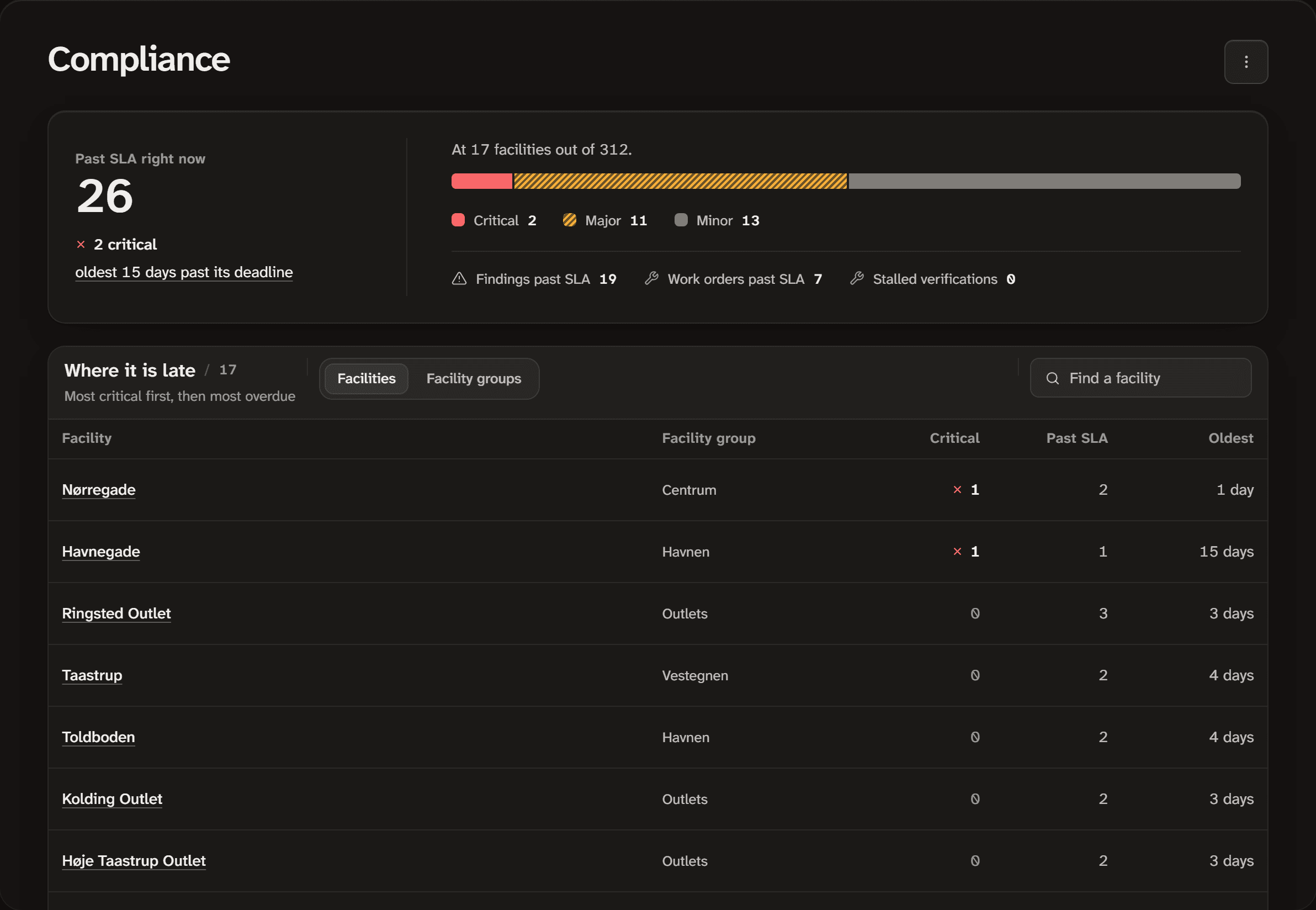
Anna, head office
Late means late, on the same clock everywhere.
A deadline is set per severity, in plain hours that run day and night at every site. Every site is measured on the same clock, so the list compares like with like, and what is on it is really late.
- The critical first
- The list starts with what could hurt someone, then whatever has been late longest, by site or by facility group.
- It climbs until someone acts
- Past its deadline, it goes to the manager of whoever holds the work, then one level up each time nobody acts, up to the owners and admins.
- The fridge is on it too
- The fridge at Havnegade has been past its deadline since 22 September, and was passed up to Anna long ago. Today’s work order does not change that; the finding leaves the list when it closes.
Anna, head office
Did every site do its checks?
One line answers it for the month: how many scheduled inspections were signed off, and how many on time. Then by facility group, site or program, for any period, until the sites that need a phone call are the only ones left.
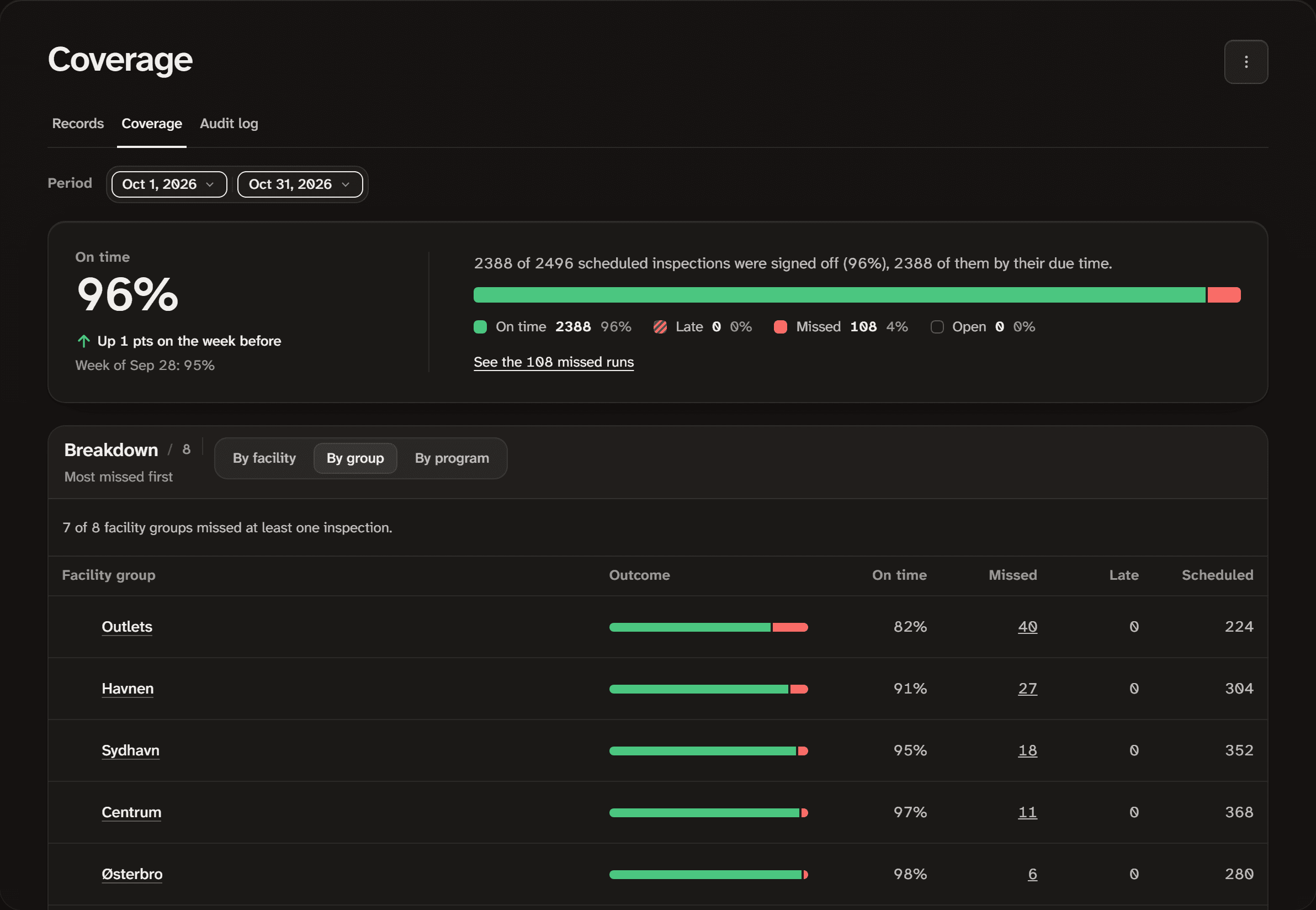
This month across all 312 sites, by facility group, most missed first. Demo data from fictional sites. - Export the breakdown
- The figures site by site export as CSV for the period you picked.
- Act on what was missed
- Open the missed runs and reassign, excuse or cancel each one. An excuse needs a reason.
Anna, head office
3 minutes for a 16‑minute check.
Fortia lists a run signed off in a third of the inspector’s own usual time on that program, or less, once there are three earlier runs to compare with. Each person is measured against their own runs, never against a colleague.
Only people who sign off or plan inspections see the list, newest first. It points to a run worth opening and decides nothing.
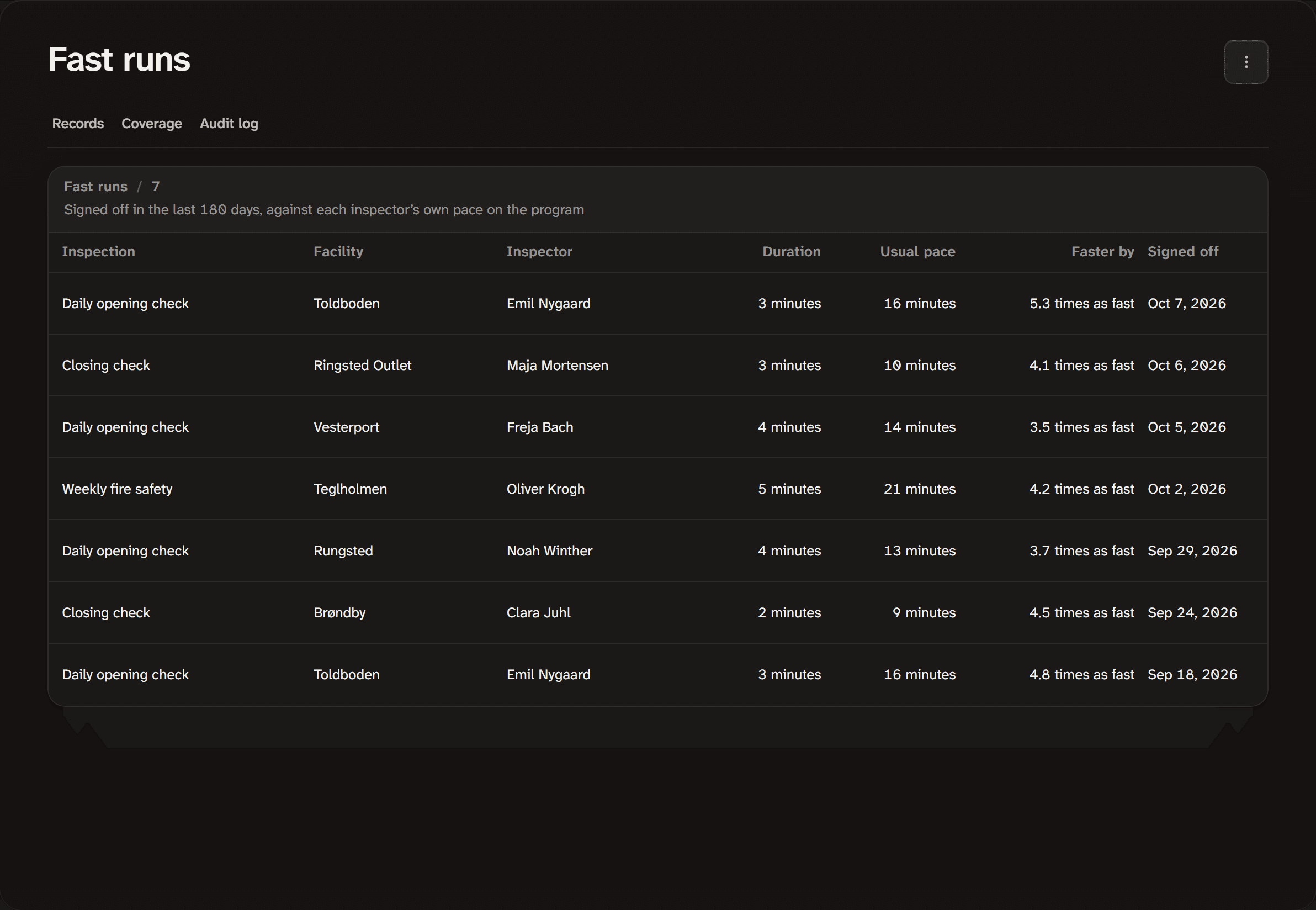
Fast runs over the last 180 days. The newest: Emil Nygaard at Toldboden, 3 minutes against a usual 16. Demo data from fictional sites. Jonas Berg, shift leader, at Havnegade
The fix is a signed record.
Once the door seal is replaced, Jonas rechecks the fridge: 4 °C. He signs at 11:03. The recheck is a record of its own: every answer, who signed it and when, and the trail behind it, ready to export as a PDF.
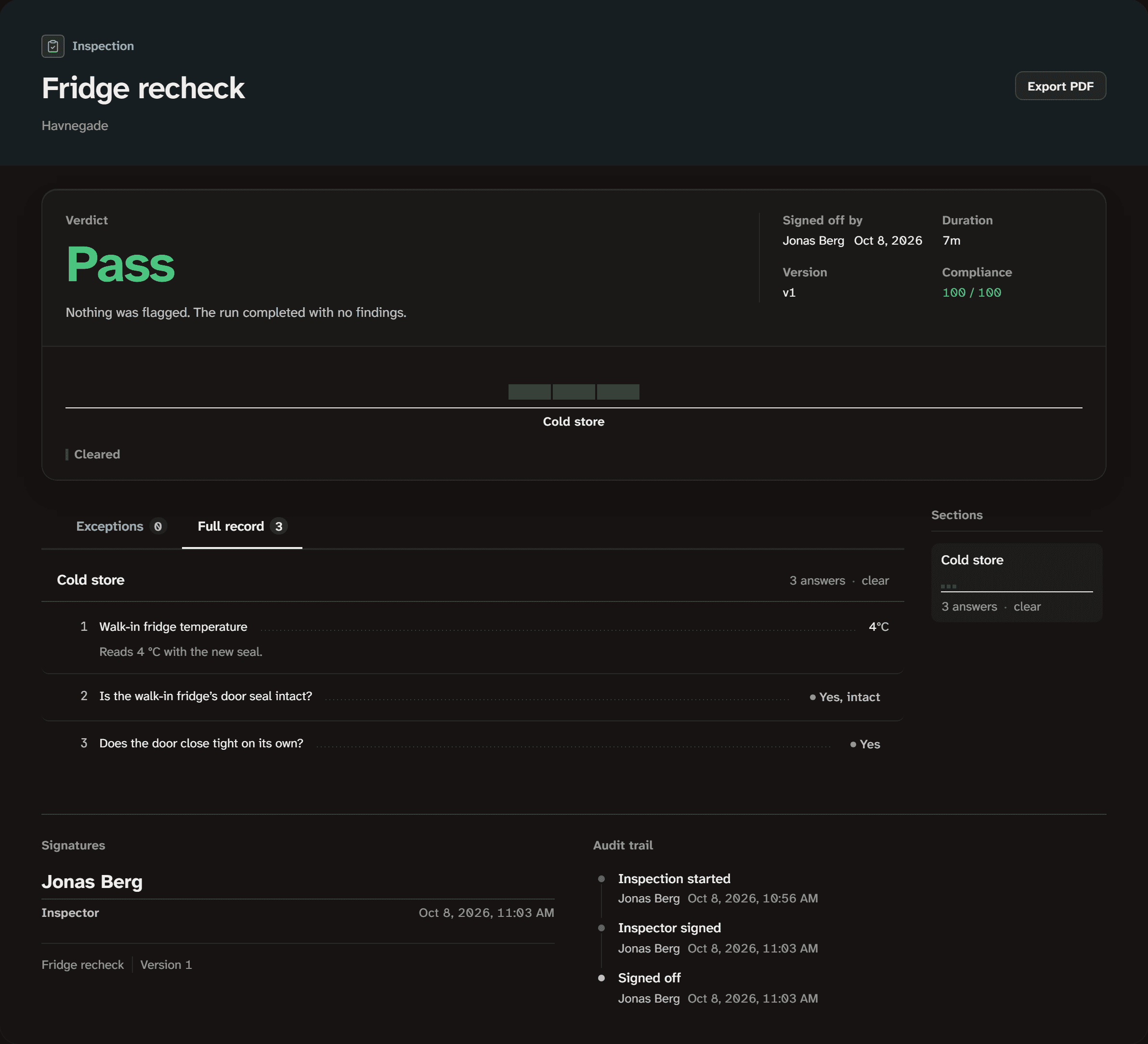
The recheck at Havnegade, signed at 11:03. Demo data from fictional sites. The auditor, any day after
One finding holds the whole story.
The fridge has one finding, not a new ticket each time it fails. It holds every sighting since 22 September, both work orders, the recheck that failed and the one that passed, each with a name and a time. Once closed, it prints as a PDF.
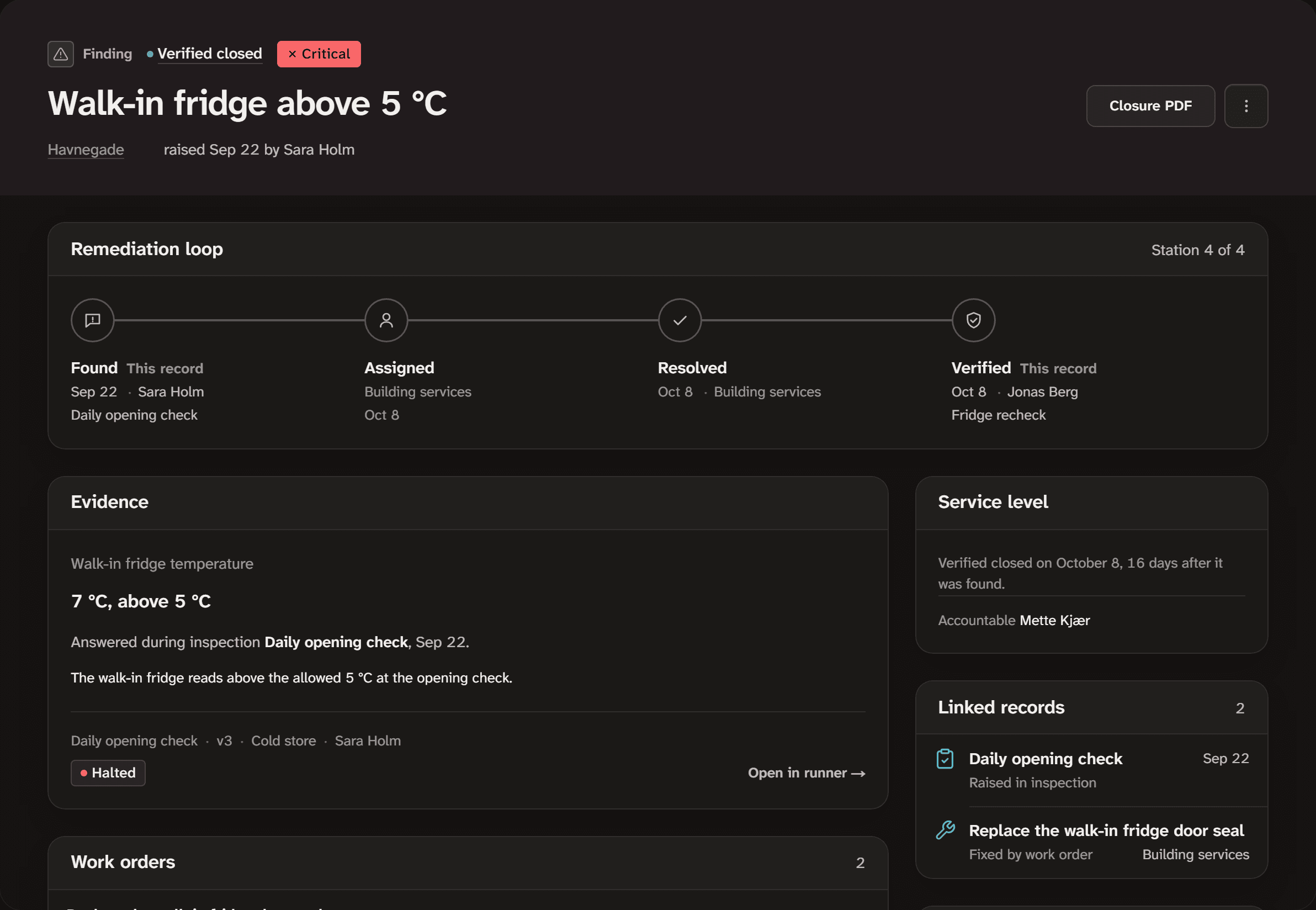
The finding, closed at 11:03 by the recheck. The run that raised it is marked halted. Demo data from fictional sites.
Why the record holds up
- A person signs
- Each run is signed by the person who did it, and countersigned by a supervisor when the program asks for it.
- Reopened, never rewritten
- A manager can reopen a signed inspection with a written reason. The signatures clear; the history stays.
- Halted stays halted
- A run halted by a critical answer can’t be signed while that answer stands. This morning’s opening check at Havnegade is not signed off.
What you can hand over
- Inspection record
- A PDF of any signed inspection.
- Finding record
- A PDF of the finding once it is closed.
- Records for a period
- Every signed inspection in the period you pick, as CSV, up to 5,000 at a time.
- Coverage by site
- Scheduled, on time, late and missed for each site, as CSV.
- Audit log
- Every inspection event for the dates you pick, as CSV.
What comes with Fortia.
Every plan, Core, Professional and Enterprise, includes everything in the first list. Professional and Enterprise add six modules, which an admin switches on or off for the whole organization at once.
In every plan
- Programs and versions
- Questions, what each answer sets off, and versions that never change under a running inspection.
- Inspections, offline too
- Answers saved on the phone first, the sign-off review, signatures and countersigning.
- Findings and work orders
- One finding per problem, its work orders, and the recheck that closes it.
- Deadlines and compliance
- Deadlines by severity, escalation, and what is late right now.
- Reports
- Coverage, records, fast runs, sites slipping against their own usual, the audit log and every export.
- Access
- Facility groups, six roles, permissions per person, and teams.
Two pieces of AI come with every plan: the sign-off review, and searching findings by meaning.
Modules, on Professional and Enterprise
- Playbook, on from the start
- A daily, ranked list of what to act on, drawn from your open work.
- AI capture
- A photo or a voice note becomes a draft finding, and regulation text a draft program.
- AI work orders
- A work order drafted when a finding is raised, for a manager to accept or reject.
- Translations
- Programs run in any of 20 languages, translated with your glossary, then reviewed and approved.
- Asset registry
- A register of the equipment your inspections run against, each item with its own QR code.
- Park operations
- For rides and attractions: a ride stays shut while its opening check is unmet or a critical finding is open.
Playbook starts on. The other five stay off until an admin switches them on.
That is the whole story. The next one is yours.